Save Your Photos

  • Home
  • Blog
  • Disaster Help
    • Disaster Resources
    • Hurricane Harvey Photo Recovery
    • Hurricane Irma Photo Recovery
  • Who We Are
    • Save Your Photos Group
    • The Photo Organizers Blog
    • Association of Personal Photo Organizers
  • Sponsors
    • How To Become A Corporate Sponsor

Sep 06 2017

We Have to Evacuate! How Do I Keep My Photos Safe?

We Have to Evacuate! How Do I Keep My Photos Safe?

If you’re looking at evacuating ahead of a storm, there isn’t time to scan your photo collection. You need to focus on ensuring the safety of your family and preparing your home as much as possible.

We Have to Evacuate! How Do I Keep My Photos Safe? | SaveYourPhotos.org


What To Do Before The Storm Hits

Here are some basic steps you can implement before the storm hits to give your photos the best possible chance of surviving the storm dry and intact.

Backup

Backup your computers and hard drives, including your photo collections. Keep a copy of your backup secure in the cloud. Bring your backup drive with you, and store another copy at a friend’s house that is out of the storm’s path.

We Have to Evacuate! How Do I Keep My Photos Safe? | SaveYourPhotos.org

Find Your Photos

Do a sweep through your basement, first floor, and garage. Do you have boxes or bins of memories stored there? Are your albums on a low bookshelf or coffee table? What about framed photos on walls or mantles? Gather them up so you can protect them. Children may be able to help with this step.

Protect Your Printed Photos

Wrap photos in double layers of plastic, sealed tight. This could mean zip-top bags or a plastic garbage bag sealed with duct tape. Smaller baggies secured inside a larger garbage bag is a good system. If any of your frames have sharp edges, pad them, so they don’t rip the bags. Don’t forget to LABEL THEM. As an added precaution, you can put the wrapped packages in a plastic bin.

We Have to Evacuate! How Do I Keep My Photos Safe? | SaveYourPhotos.org

Plastic bins may be water resistant but are not water tight. Floods can lift and carry heavy boxes, and can tip them over, so the water gets in.  Make sure everything in the bins is wrapped in plastic.

You can put a few desiccant packs (like the ones that come in shoe boxes) in the container, making sure the photos are wrapped up separately and protected from any chemicals.

Get To Higher Ground

Move the bins of wrapped up photos to the highest level of your home and choose an upper shelf of a bedroom closet or any closet on an upper floor. A closet will keep bins from floating around or tipping.


Above all stay safe, and we wish you all the best as you weather the storm and its aftermath. Visit saveyourphotos.org to learn what to do after the storm with any water damaged photos.


Kathy Rogers of Baltimore Photo SolutionsKathy Rogers loves photos and the stories behind them. Since 2012, as the founder and CEO of Baltimore Photo Solutions, she has been helping others to preserve their photos and share their legacies. She is a certified photo organizer and APPO member. 

Kathy’s first career was in health care. She brings lessons learned from her public health training into her photo books for families dealing with dementia and now, in blogging about disaster preparedness.
We Have to Evacuate! How Do I Keep My Photos Safe? | SaveYourPhotos.org

Written by Andi Willis · Categorized: Photo Storage, Safeguard · Tagged: backup, disaster preparation, emergency preparedness, how to keep my photos safe, how to store photos, hurricane, photo storage

Sep 06 2017

Save Your Photos: Digital Photo Folder Structure

Save Your Photos: Digital Photo Folder Structure

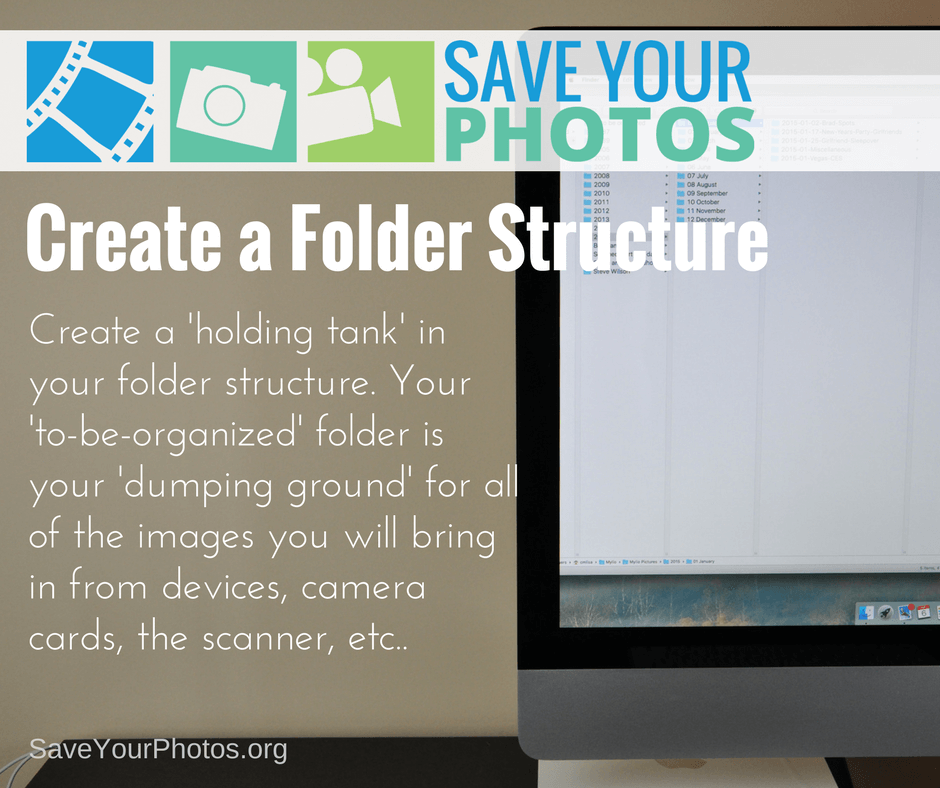
Create a ‘holding tank’ for your messy digital photos in the folder structure of your digital photo hub. Your ‘to-be-organized’ folder is your ‘dumping ground’ for all the images you bring in from devices, camera cards, the scanner, etc.

Save Your Photos: Create A Digital Folder Structure | SaveYourPhotos.org

Create Some Structure in Your Life

Now that you’ve chosen your digital photo hub, let’s create some structure. We recommend a folder structure that is scalable, and easy to understand.

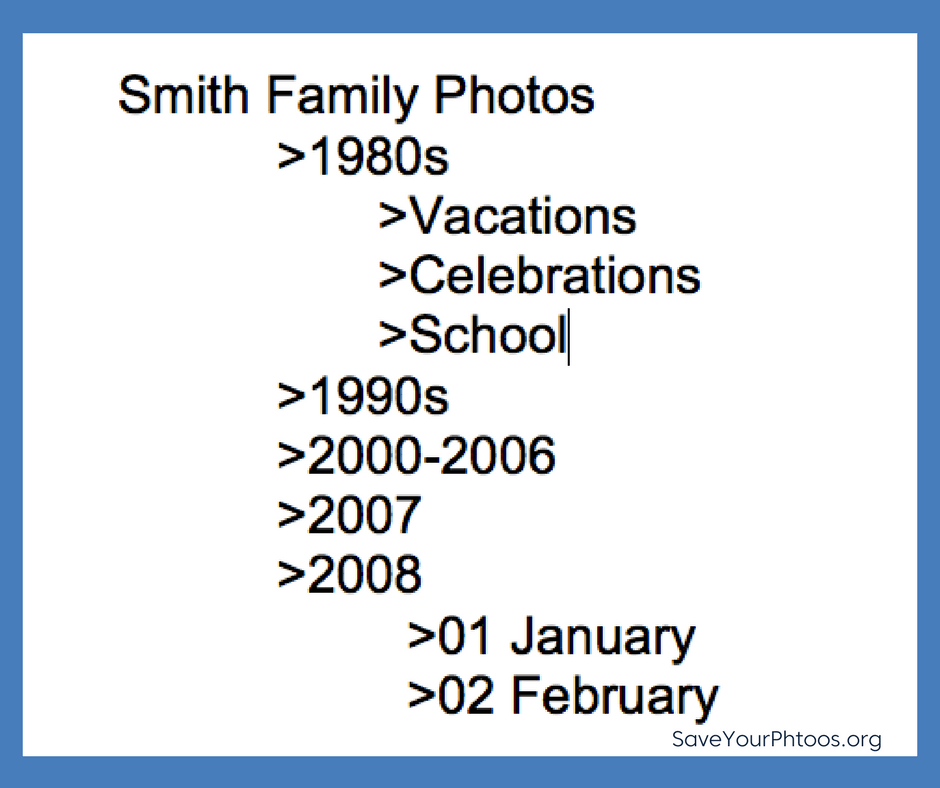
For example, a dated folder structure is predictable and easy to maintain because today’s digital images have dates embedded. Themed folders with no ‘dated’ structure work better for old scanned photos that are hard to date. Use a numerical file name for your folders which allows your computer to sort your folders in date order. Here is an example of a scalable folder structure that incorporates both:

Save Your Photos: Create A Digital Folder Structure | SaveYourPhotos.org

Create a Holding Tank: To-Be-Organized

Eventually, your sorted images will go into this folder structure, but first, we need to create a ‘holding tank’. This one folder in your hub will denote images that need sorting. Your ‘to-be-organized’ folder is your ‘dumping ground’ for all the images you bring in from devices, camera cards, the scanner, etc.

Start to Sort

Once you have your structure in place, you can start pulling in images from all your devices. Next week we’ll give you some specific tips to help streamline this work so don’t jump in just yet.

Stand Alone File Structure

One final thought about the importance of this structure. You will notice that we haven’t introduced any photo organizing software yet. We believe this structure is a ‘friendly’ option for everyone and ensures that your workflow is software independent. If you aren’t currently using a software program to organize your photos, the added learning curve may slow you down or paralyze you. We’ll teach you how to organize your photos without a specific software and we’ll leave the decision to introduce software up to you.


Sign up today for more great photo organizing tips directly in your email box.

We also invite you to visit our sister blog The Photo Organizers for more tips and in-depth knowledge from some of the top photo organizing industry professionals. To find a photo organizer near you, visit the Association of Personal Photo Organizers.

Written by Andi Willis · Categorized: Photo Organization · Tagged: digital photos, how to organise digital photos, how to organize digital photos, photo organising, photo organizing

Aug 30 2017

Save Your Photos: Create Your Digital Photo Hub

Save Your Photos: Create Your Digital Photo Hub

Your digital photo hub is the one location where you will store all your original images. Designating a ‘hub’ is the key to keeping your photos organized and backed up.

Save Your Photos: Your Digital Photo Hub | SaveYourPhotos.org

Choosing your digital photo hub is the most important decision you will make when organizing your digital pictures, so let’s dig in.

Your Digital Photo Hub = Your Digital Home

You’re going to create a digital photo hub to store every photo (and video) you take including your soon-to-be-digitized prints and home movies. Your ‘hub’ will be the ‘home location’ for your entire memory collection and can be a master folder on your computer hard drive, an external hard drive or in some cases a cloud-based location. When you have a designated hub, you will find it easy to backup your memory collection and you will simplify your workflow significantly.

Create a single digital hub for all of your digital photos and videos. #saveyourphotos Click To Tweet

Things to Think About

Here are a few things to consider when choosing your ‘hub.’

1. Does your hub have the capacity to expand?

Chances are, you’ll continue to take photos and videos. If you locate your hub on an external hard drive or your computer, then you need to ensure you have ample storage space for your existing images and your future ones. High-resolution images and videos require a lot of space, so choose wisely.

2. Is your hub accessible and within your complete control at all times?

You should have access to your photos whenever you need to which means your hub needs to be stored locally, and not online. The only exception to that rule is if you are living an entirely mobile life where you aren’t tethered to a home computer.

Save Your Photos: Your Digital Photo Hub | SaveYourPhotos.org

Cloud Questions

Mobile devices don’t have the capacity to store your entire collection, making a cloud-based solution your only option. If you need to choose an online service, pick a reputable established provider and read the fine print. Ask about privacy (protecting your image info), photo ownership, data stripping (removing your metadata or compressing your images) data mining (sharing your personal info for advertising purposes) and how you retrieve your images if you decide to ‘break up’ with your provider. Some online services make you pay to download your own pictures. Buyer beware!

What’s In a Name?

Finally, give your hub a name that makes it easy to locate. Smith Family Memories is a good example. My Pictures or Pictures is a little too vague.

Where will you locate your digital photo hub?


Sign up today for more great photo organizing tips directly in your email box.

We also invite you to visit our sister blog The Photo Organizers for more tips and in-depth knowledge from some of the top photo organizing industry professionals. To find a photo organizer near you, visit the Association of Personal Photo Organizers.

Written by Andi Willis · Categorized: Photo Organization · Tagged: cloud storage, digital photo hub, digital photos, how to organise digital photos, how to organize digital photos

Aug 23 2017

Save Your Photos: Start With Your Digital Photos

Save Your Photos: Start With Your Digital Photos

Tackle your digital photos first. Your images may be at greater risk than your printed photo collection if you don’t have sufficient backups in place.

Save Your Photos: Start With Your Digital Photos | SaveYourPhotos.org

You may be tempted to start with your printed photos, but we have a good reason for tackling your digital photos first!  We asked Certified Photo Organizer Caroline Guntur of Organizing Photos by The Swedish Organizer why she recommends starting with your digital images and she gave us 4 GREAT reasons.

Tech Failure Rates vs. Natural Disaster

Consider this fact: Statistically, you are more likely to lose your digital photos in a tech crash than your analog memories in a house fire or other natural disaster.

It’s no secret that hard drives fail. Lots of phones are stolen every day. Computers shut down, never to be powered on again. In other words, your device is the most likely culprit when it comes to lost memories, not a natural disaster.

Is it always accurate? Of course not. No disaster or accident should be treated casually, so you’ll have to consider the dangers that your photos face, and make a good judgment call, but in general, I tend to acknowledge this statement as fact. I live in a low-risk area, and I know for sure that my photos are more at risk on the tech side. Every project needs a plan of action, and if you’re statistically more likely to lose your digital photos, why not start by keeping those safe?

4 reasons you should start organizing your digital #photos today #saveyourphotos Click To Tweet

Most of Your Photos are Digital

If you lose your digital collection, you’ll probably end up losing more photos, maybe even most of them. I mean, aren’t the majority of your photos digital? I’d bet my last quarter on the fact that most of your photos are digital, even if you have lots of prints. If you’re anything like me, you’ve probably taken more pictures in the last few years of smartphone-clicking than in the past few decades combined (unless your polaroid cam was working overtime!).

Save Your Photos: Start With Your Digital Photos | SaveYourPhotos.org

Intangible Memories are Easier to Lose

Digital photos are easier to lose because they’re not tangible. Printed photos are usually stuck in a box somewhere, and are relatively safe if you store the box well. You’re not that likely to forget about it. Digital photos, on the other hand, are usually scattered on different devices and across different platforms, and they don’t come together as quickly. You just haven’t looked at them enough to remember all of them, so they’re easier to forget. You’ve never held them in your hand, and that makes a big difference. Many studies show we relate better to things we touch, so I have to believe that tangibility matters. It’s much easier to forget about a few photos on an individual device than about a box of prints that you can physically see.

A Digital System Makes Maintenance Easier

It’s not uncommon for the photo organizing process to take a few weeks, and sometimes clients take hundreds of new photos while we’re in the organizing mode. Without a system in place to deal with all the new digital photos, the to-do list keeps growing, and the project never ends. I like to think of it as a conveyor belt. The photos are just going to keep coming, so it’s easier to quickly set up the conveyor belt to go in the right direction rather than having to deal with an amassing pile of files. Why add more to the mess? With a digital system in place, it’s easier to maintain order, and when your older printed photos are ultimately scanned, it’ll be much less work to add them to your collection.

What do you think? Are you ready to tackle those digital photos?


Sign up today for more great photo organizing tips directly in your email box.

We also invite you to visit our sister blog The Photo Organizers for more tips and in-depth knowledge from some of the top photo organizing industry professionals. To find a photo organizer near you, visit the Association of Personal Photo Organizers.

Written by Andi Willis · Categorized: Photo Organization · Tagged: appo, digital photos, how to organise digital photos, how to organize digital photos, organise digital photos, organize digital photos, photo organising, photo organizing, save your photos

Aug 16 2017

Save Your Photos: Collect Your Photo Organizing Supplies

Save Your Photos: Collect Your Photo Organizing Supplies

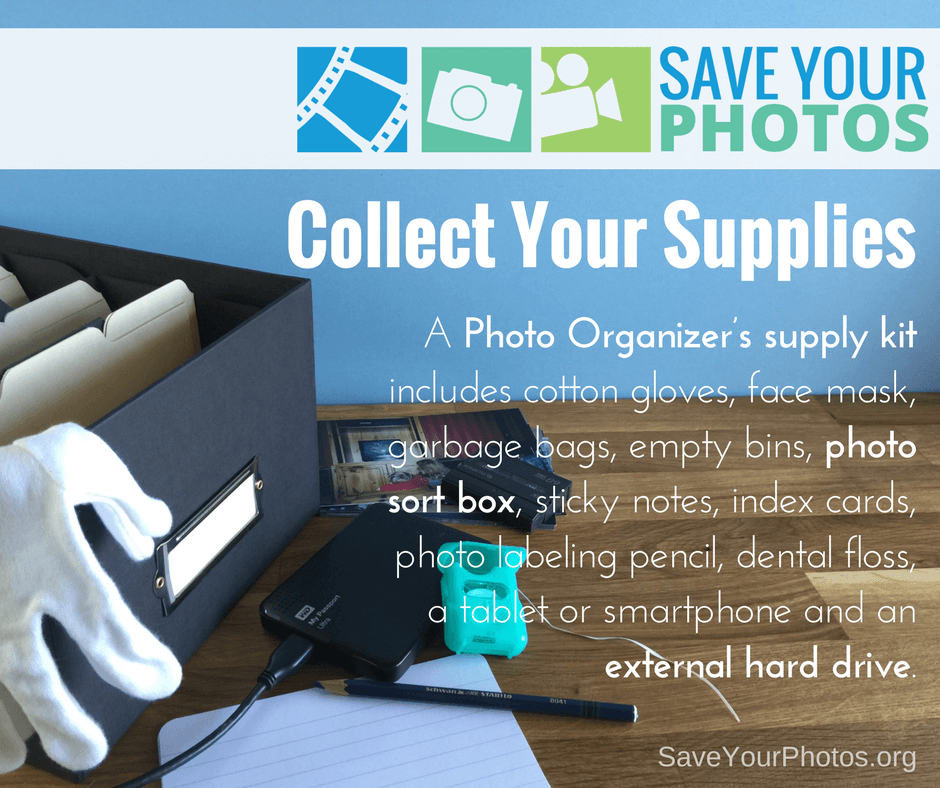
The proper photo organizing supplies are an important part of your photo organizing project. A Photo Organizer’s kit includes many different items that make the job of handling, identifying and storing your precious lifetime of photos.

Save Your Photos: Collect Your Photo Organizing Supplies | SaveYourPhotos.org


What the Experts Use

Before you get down to the business of organizing your photos, you’ll need to collect some photo organizing supplies. We polled Professional Photo Organizers for their supply list; these are the ‘must haves’ when they begin any photo organizing project.

Cotton Gloves

Fingertips contain an oily residue that will further deteriorate your delicate photo.

Face Mask

If your printed photos smell musty, or they were stored in an attic or basement they may contain mold spores that you could find irritating during the sorting process.

Gather these helpful #photo organizing supplies that the experts use. #saveyourphotos Click To Tweet

Soft-lead Blue or Black Art Pencil

As you sort photos you may want to include a date, year or name on the back of a photo. This pencil is not permanent, and will not indent or harm your photo until you can capture the details digitally once scanned. Never use a pen to mark the back of your photo.

Index Cards

Jot down more details, facts, stories and dates on index cards and group them with printed photos. Index cards can be scanned with printed photos, so important details remain grouped together.

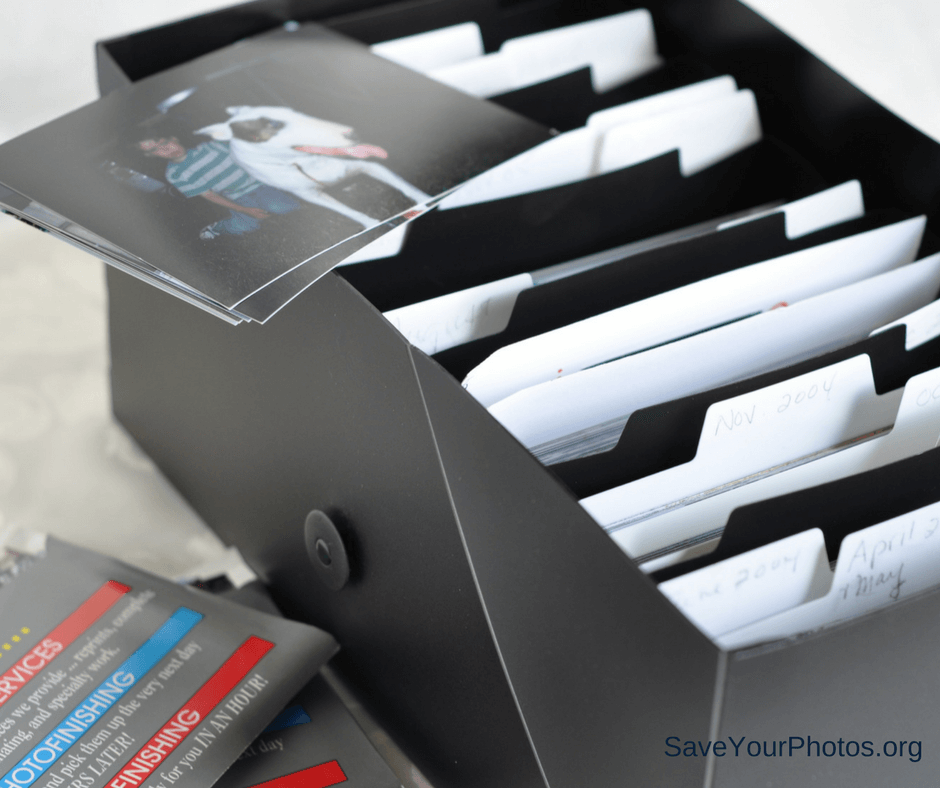
Archive Quality Photo Safe Storage Box

Choosing a good quality photo box will keep your photos safe, and aid in the sorting process.

Save Your Photos: Collect Your Photo Organizing Supplies | SaveYourPhotos.org

Dental Floss and Hair Dryer

If you have peel and stick albums, some of your photos may be difficult to remove.

Smartphone Camera

If you have old albums with details on the page, you can take a snapshot of the page to keep the details with the photos.

Sticky Notes or a Notebook

These come in handy for creating a timeline during the sorting process.  Some organizers use apps like Evernote or OneNote to curate information or create timelines.

External Hard Drive

Choose a high capacity drive according to the amount of images you have.

Garbage Bags

You’ll come across toss-away pictures, artwork and meaningless ticket stubs that will help reduce your clutter. Let’s set a goal to fill a bag!

These are the essentials, but you may have some more ideas too. Whatever makes your job easier, add it to the list.

What are your must-have photo organizing supplies?


Sign up today for more great photo organizing tips directly in your email box.

We also invite you to visit our sister blog The Photo Organizers for more tips and in-depth knowledge from some of the top photo organizing industry professionals. To find a photo organizer near you, visit the Association of Personal Photo Organizers.

Written by Andi Willis · Categorized: Photo Organization · Tagged: appo, photo organiser, photo organising, photo organizer, photo organizing, photo supply kit, photo tool kit, photo tools, save photos, save your photos

  • « Previous Page
  • 1
  • …
  • 4
  • 5
  • 6
  • 7
  • 8
  • Next Page »

© Copyright 2017 Association of Personal Photo Organizers · All Rights Reserved · Privacy Policy