Save Your Photos

  • Home
  • Blog
  • Disaster Help
    • Disaster Resources
    • Hurricane Harvey Photo Recovery
    • Hurricane Irma Photo Recovery
  • Who We Are
    • Save Your Photos Group
    • The Photo Organizers Blog
    • Association of Personal Photo Organizers
  • Sponsors
    • How To Become A Corporate Sponsor

Aug 25 2016

Timeline of Our Family

Timeline of Our Family

This is a guest contribution by Rhoda Gordon of Sunflower Photo Solutions.

Gordon Post

Are you searching for one more excuse to print out your photos? This is it! I have a great idea that my sweet husband gets all the credit for. When we got married, he suggested we take a family picture each year to hang in our home. This is what we have done for the last 26 years which have become a timeline of our family.

These pictures hang in our study about 6 inches below the ceiling and span all four walls. They march in progression from the first, which is our wedding photo, to the last, which was taken only a few weeks ago.  We chose the study because, at the time, this was a room that would be used by all family members. Remember the days of one large, desktop computer?  Well, our study still gets a lot of use.

Gordon #1
These pictures not only tell the story of our family, but they also are an insight into how capturing images has changed over the years.  The first ten years or so we had professional photos shot, then we began to shoot our own because taking quality photos became easier. Hmm, it was either because the digital cameras were introduced, or the fact that we no longer had squirming children. The only thing consistent about the images is the people in them, but I defined a collection by giving them the same look and feel with simple black framing and a consistent size.

Years_GordonFamily copy
It is a wonderful feeling to look back and see how our family has grown, to see the progression of the kids and how my husband and I have aged.  Some of the images are posed but as we all have gotten older, more of them are casual and some downright silly. This reflects the personality of our family and how we live our life. This is the timeline of The Gordon Family and I am so happy my husband thought of it!


Rhoda
Rhoda Gordon

Rhoda Gordon is the founder of Sunflower Photo Solutions, a photo organizing, scanning, and preservation firm. Photography is in her blood. She comes from a long line of photo and photo equipment enthusiasts going back several generations. She has been organizing photos, creating slideshows and photo books most of her adult life. Now she helps others do the same. Her services include print and digital photo organization, image and document digitization, slideshow and photo book creation, photo restoration, and personal training in all of the aforementioned.

Her career began as an electrical engineer working for AT&T Bell Labs, Lucent Technologies, and more recently, Rhoda has been teaching at Brookdale Community College. She is a certified personal photo organizer and a member of APPO (Association of Personal Photo Organizers). Rhoda is dedicated to her craft and continually takes ongoing education to keep up with the latest technology. She was raised in Monmouth County, graduated from Rutger’s University and currently lives in Freehold, NJ.

Rhoda is a wife and mom of 3 beautiful children; one daughter in graduate school, another one in college, and a son in high school. She loves spending time with them, her wonderful husband and their basset hound, Rambo. She also has found the time to be a committed volunteer for CentraState Medical Center and its foundation since 1995.

Rhoda’s passion is helping others preserve their beautiful memories in a way that they can revisit them again and again. She believes that pictures tell the story of our lives, and that of our families.

Let her help you tell and preserve your story.
 

Written by Jackie Lyals · Categorized: Creating Memories, Displaying Photos, Photo Storage, Printing

Aug 10 2016

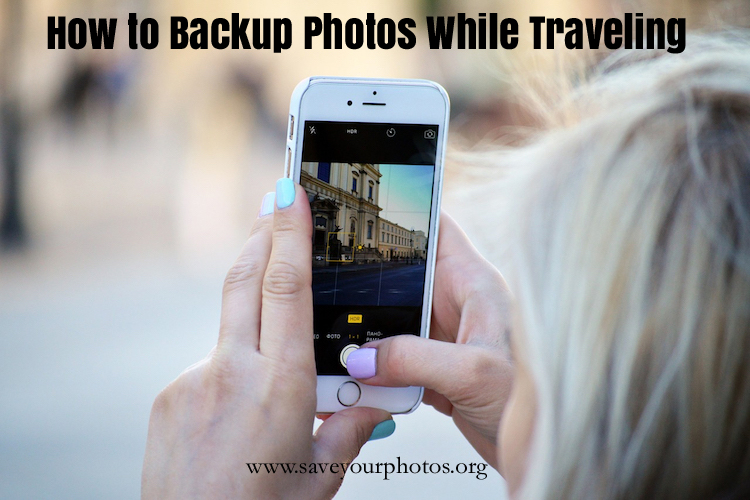
How to Backup Photos While Traveling

How to Backup Photos While Traveling

This is a guest contribution from Chantal Imbach of Simply In Order

Travelling

Do you know anybody who doesn’t take photos while traveling? Well, certainly not me! Modern technology enables us to take photos very easily and we often not only use a digital camera but also our phone or other devices to take photos.

However, these things can easily get lost, stolen, or damaged and you might lose all of those precious photos you took (possibly even those taken before your trip if you haven’t got a backup system in place). So, what can you do to keep your photos safe and backed up during your trip?

Below are some options for various needs and budgets. Just go through the list and find which method suits you most. You may even vary between methods from one trip to another depending on where you go.

Photo organizers recommend that you save three copies of a photo. This might not always be realistic while traveling but keep it in mind. Also, downloading your photos to a backup place and then deleting the photos on your camera is not a backup – it’s just a relocation of your photos!

Technology changes all the time so please do your own research with regards to the equipment you need.

Backup from a Phone

To the cloud (automatically or manually)

If you’ve got internet access it is a great way to backup your photos. Especially because we recommend that you not only have three copies of a photo but also in two different locations.

I recommend checking out two of APPO’s partners – either Forever or Mylio.

Dropbox has worked well for me in the past. There are of course lots of other services such as iCloud, Google+, OneDrive, etc.

A word of caution: read the small print of all providers before you make a choice. As an example: there are some who will charge you if you want to download your photos from their cloud service or with some of them you won’t get back the original resolution or you might have to download them one by one.

To a portable hard drive with WiFi

Together with the right app (depending on your phone) you can upload your photos wirelessly to a portable hard drive. An example is Seagate Wireless Plus.

To a portable hard drive without WiFi

This is a bit trickier because you will need a computer via which you can copy your photos to (see below how to do this). Don’t shy away from the idea of using a portable hard drive. I use Seagate all the time and they’re really light and small; perfect to carry around.

To a computer

If you take a laptop on your trip you simply need to connect your phone to your computer and copy your photos. To be even safer you could then copy the images to an external hard drive or USB to backup your computer – et voilà: you’ve got your three copies.

You may also use a computer in a hotel business centre or in an internet café if you travel without your own.

To a USB flash drive for smartphones and tablets

There are various USB flash drives which you can connect directly to your phone and download your photos to. They come in various sizes and are pretty easy to carry around. This is definitely a favourite of mine.

Examples are the PictureKeeper, SanDisk iXpand, or SanDisk Ultra Dual Drive.

As an option you can also buy adapters to connect your phone with a regular USB flash drive.

To a tablet

The fastest way if you don’t have internet access is probably to use Airdrop, which creates a peer-to-peer network. SHAREit works similarly.

To an SD card

Some Android phones actually include a mini SD card. Make sure in the settings that this is where the photos are stored. If you want to transfer photos from the SD card please see below for options.

iPhones cannot export or copy photos from the phone directly to an SD card. It is only possible via a computer.

Backup from a Camera Memory Card

Remove the memory card from your camera (or your Android phone) and use a card reader to import the photos to a computer, your phone, a tablet, or another mobile device. Make sure you have the correct reader/s and adapters with you.

If a computer and a portable hard drive is too much to carry along, a memory card backup system like Nexto DI or Hyperdrive might be the ideal solution. They are like a hard drive with slots for the memory cards and come with a display as well.

Backup from a Camera via USB Connection

Connect the camera to a computer via the USB cable and copy your photos. While you’re at it, you could make another copy to an external hard drive or to the cloud if you have internet access.

Wireless Backup from a Camera Memory Card

Invest in an Eye-Fi memory card which can transfer photos wirelessly to your device or computer. Keep in mind that the camera will have to be powered on while photos are transferred which requires battery power.

Once you have copied the photos from your camera to a computer or other device, you can use the above-mentioned tips to back these up.

Before You Travel

  1. Work out a backup plan that suits your needs.
  2. Make sure you have all the necessary equipment formatted correctly (especially portable hard disks).
  3. Don’t forget at least one international power adapter.
  4. Think about how you want to transport these things so they stay organized and safe. I like zip lock bags (protects against humidity and dirt at the same time). Also try to keep the camera away from the backup.
  5. Make sure all your cameras always have the correct date/time setting (of the time zone you’re in when taking the photo). It will make your life a lot easier because you will automatically have the correct chronological order (especially if you use several cameras and devices).
  6. Once your trip has started, keep in mind to set aside some time to backup your photos regularly.
  7. Enjoy your holiday!

After Your Trip

Remember, these backups are meant to happen while you’re traveling. If one of the copies you made is now already in your photo hub (e.g. if you used Forever or Mylio) it will save you the time to download everything again. If they are not in your usual hub yet, you’ll have to download your photos as soon as possible and use your usual photo management workflow.


2013_04_08_Chantal – Version 3
      Chantal Imbach

Living in a beautiful but also very fire prone area outside Melbourne (Australia) has triggered Chantal Imbach’s passion for keeping photo collections safe and organized so they can be passed on to future generations in a meaningful way.

Starting out as a home declutterer and organizer, she has now specialized in digital photo organizing and shares more of her tips in her blog at Simply In Order.


Written by Jackie Lyals · Categorized: Backup, Photo Organization, Photo Storage, Safeguard

Aug 03 2016

3 Things You MUST Know About Cloud Storage

3 Things You MUST Know About Cloud Storage

This is a guest contribution from Shelley Murray, Executive Sales Director of Forever

Forever_BlogPost

In the hustle and bustle of our digital age, we are often too quick to click the checkmark on the Terms of Service field when signing up for things online. But, have you ever stopped to read the pages and pages of conditions to which you are agreeing?

Our family photos are among our greatest possessions. Yet, we freely upload them to “The Cloud” without even thinking about whether or not they are truly safe there. Over the last 3 years, I have worked with numerous clients, helping them get their photos organized and preserved permanently. I have had first hand experience with Shutterfly, Flicker, MyLife, Google, Amazon, Dropbox, Walgreens, Costco and Apple iCloud. And I’ve been shocked by what I’ve learned about these cloud storage sites. When I outline the three biggest reasons why, my customers are usually just as shocked.

It’s amazing how trusting we tend to be, and how quickly we fall for the word “free”. Lets take a look at these 3 crucial points:

#1 – No Privacy or Security: Digital Rights & Data Mining

This is important. When you upload your photos to these sites, they immediately claim ownership of the digital rights to your photos. To my knowledge, all cloud storage sites are like this, with the exception of Dropbox.

To follow are some excerpts from the Terms of Service from several popular photo storage companies as of Feb. 2016:

Google: “When you upload, submit, store, send or receive content to or through our Services, you give Google (and those we work with) a worldwide license to use, host store, reproduce, modify, communicate and publicly display such content.” Also, “Our automated systems analyze your content (including emails). … This analysis occurs as the content is sent, received, and when it is stored.”

Nothing is free!

Membership at these sites is costing you your privacy. Once they own the digital rights to your photos, you become the product that they are selling. Yes, you are both the customer and the product. They are selling your habits, your interests, and your personal information as marketing collateral to large companies. Your information is extremely valuable for these billion dollar companies; it’s how they became billion dollar companies in the first place. The more photos you upload, the more money they make by watching what you do with those photos. A friend of mine uploaded photos to Amazon of her kids playing soccer and wearing Under Armor. Next thing you know, she began receiving all kinds of advertisements from Under Armor. Data-mining your life is the reason why these companies are so profitable and successful.

#2 – No Permanence

Do you trust that your photos will be available on these sites tomorrow? You should. Yet, according to the Terms of Service, there are no guarantees.

iCloud: “Apple may at any time, under certain circumstances and without prior notice, immediately terminate or suspend all or a portion of your Account.”

Shutterfly: “We may terminate your access to our Sites and Apps and to your account at any time, with or without cause, and with or without notice.”

Drop Box: “We also reserve the right to suspend or end the Services at any time at our discretion and without notice.”

In the last 10 years, three photo sites have terminated my account and taken down my photos: Kodak, Creative Memories and most recently Costco. They did give me warning, but I never got around to downloading the photos and double-checking to ensure I had a second copy. Though I am pretty sure that I did have a second copy available digitally, others may not be so lucky. According to the terms of service, this termination can happen without any notice.

#3 – No Succession Plan

What happens to your photos if you die? Will your loved ones know which sites they are store on? What about the passwords? What if you have them stored on a site in which you pay a monthly fee? Will your family know to continue paying that bill for the next 50 years? What happens if your monthly payments are not made? Yes, your account will be terminated. Your photos, taken down. Sadly your photos will not outlive you; none of these sites guarantee a succession plan. Basically, according all of the available Terms of Service, these accounts terminate upon your death and they cannot be transferred to anyone else.

iCloud: “You agree that your Account is non-transferable and that any rights to your Content within your Account terminate upon your death.

The three points I have outlined above are so very important when it comes to deciding where and how you will store your precious family photos. I am not going to leave you here without giving you a solution to this problem. At Forever, we have been busy for the last three years creating a company and pledging Terms of Service that are beneficial to our members. We have taken all of these considerations in mind and have provided the solution that we ourselves would look for in a Terms of Service. My team and I have helped to create a place to keep my own photos permanently, privately, and securely. Yet, I also want to share them with my family and friends and have easy access to them on all my devices. Forever.com meets all of these needs and desires.

Forever.com offers a permanent digital home for your precious photos, documents and soon video. With Forever, you purchase an account and become a member by making a one-time payment (or, if you choose, it can be paid off over time.) Once a member, you own the digital rights to all the content you upload; we do not. We will never sell your information to third parties, your account will never be terminated, and we have instituted a succession plan, so that your future grandchildren and great grandchildren will be able to enjoy your treasured memories.

Think of Forever as a photo insurance company. When you purchase your account, the majority of that money goes right into a fully-restricted fund that is used to maintain your photos on our site. It also pays for any possible file format migrations that may be necessary as technology changes. Right now we normally save our photos as JPEGs, but it will surely be a different, more advanced format in the future. So, 100 years from now, your ancestors will be able to enjoy your photos in whatever format they are using at that time. As you can see, Forever gives you all the tools you need to collect, curate and celebrate all of your treasured memories.

Take a brief 90 Second Look at Forever


IMG_0459Shelley Murray is an avid memory maker and memory keeper. She has always had a love for photos and scrapbook design.  As an executive with Forever, she is passionate about sharing their unique mission with others. She has worn many hats at Forever over the last three years. But, her favorite is simply helping others learn how to organize, preserve and enjoy their photos.

Written by Mary · Categorized: Backup, Photo Storage, Safeguard

Jul 26 2016

Get Started on Saving Your Photos

Get Started on Saving Your Photos

This is a guest contribution by Meaghan Kahlo of Ephemera Photo Organizing

Emphera Post 2

The goal of the Save Your Photos effort is to simply get you started on saving your photos. Just taking a step in the right direction towards saving your photos from accidental loss.

One of the biggest steps that can be taken is also one of the simplest and can result in the most beneficial change for your photos.

It’s all a matter of finding where you have been stashing your photos and moving them into your living spaces. One step, one goal, find your family photos and papers and move them to a safer location.

The attic, the basement, the garage, the storage unit. These spaces are for camping gear and gardening equipment not for our valuable family archives that are made up of vulnerable media including photographs, papers, slides, negative, film and audio reels, memorabilia, and albums.

Poor storage conditions can have detrimental effects on irreplaceable family memories. Years of temperature and humidity fluctuations will have an impact on the quality and condition of your memory collections potentially causing myriad issues. Dirt and dust may collect in deteriorating storage boxes. Pests may be attracted to paper and glue. Acetate film layers can begin to degrade and break down. Paperclips, staples and film containers can rust. Tape yellows, turns to dust, and becomes difficult to remove.

The main living spaces of our homes are generally the most consistently stable since we keep it that way for our comfort. Family photo and archive collections will benefit and last much longer living with you. Plan to take action and carve out a safe space in your living room, hall closet or guest bedroom to relocate your family photos and important history.


2016_Profile_Thumb
Meaghan Kahlo

Meaghan Kahlo, owner of Ephemera Photo Organizing in Seattle, WA, began her professional life with graduate work in museum studies focused on collections management. Her enthusiasm for photography and historical preservation combined with a passion to organize and create order are the driving forces behind her business. Meaghan helps clients transform the ephemeral nature of digital and printed images into meaningful photo solutions for loved ones today and for generations to come tomorrow.

Written by Jackie Lyals · Categorized: Creating Memories, Photo Organization, Photo Storage

Aug 18 2015

How To Rescue Photos from Magnetic Albums

How To Rescue Photos from Magnetic Albums

This is a guest contribution from Meaghan Kahlo of Ephemera Photo Organizing.

Magnetic Photo Albums
Your parents almost certainly have some. Maybe you have a few. They seemed like such a good idea at the time! So affordable! How could we have known the problems they would cause?

Acidic, cardboard pages. Covered in yellowing, sticky adhesive. Encapsulated in plastic sheeting. Spiral bound or three-ring binders. The magnetic photo albums so ubiquitous in the 1970s.

Personal photo organizers, archivists and conservators all agree that these inexpensive albums are among worst places to store your precious family photos. Your photos desperately need to be rescued from these cheap and harmful albums that have been their home for the past several decades.

What kind of damage have these albums been causing to your photos over the years? The cardboard pages are highly acidic and seep peroxide, yellowing both black and white and color prints. The tacky glue that seemed like such a convenience is also highly acidic and will slowly deteriorate the prints. Additionally, the glue breaks down, hardens and fuses the photo to the page making it difficult to remove. The cheap plastic overlay to the pages exacerbates the deterioration of the photos by off-gassing and sealing harmful chemicals in close to the photo print itself. Deterioration of prints in this type of album is hastened further if the albums are stored in unstable environments like the attic or basement where temperature and humidity fluctuations can wreck even more havoc on fragile images.

Personal photo organizers, archivists and conservators have developed certain techniques to help release photos from pages of the destructive1970s magnetic albums. These techniques are employed with the intention to prevent further damage to the photos themselves.

Waxed dental floss has been an effective tool for releasing photos from the pages. Slide the dental floss under a corner of the photo and gently saw through the glue as you pull the floss behind the photo. Take care not to tear the photo paper or bend the photo and crack the emulsion surface. Sometimes a small hair dryer on low or warm will be helpful to soften the glue just enough to slide the floss through. Take care not to overheat the page or the photo causing additional damage.

A product called Un-Du is available, generally utilized to remove labels and stickers. Place a small drop of Un-Du on a rounded, dull crafting spatula and slide the tool through the glue to help release a photo. Take care to use the smallest effective amount of Un-Du with each photo.Some pages will likely release the photos easier than others. Others could be a bit of a struggle. If the photo or photos are stuck hard to the page or to each other, scanning the entire page may be the simplest approach.

Finally, take care to preserve any notes or inscriptions from the album that go along with the photos before discarding the old pages. Sometimes this style of album just had a paper sheet at the beginning of the album where dates, places and names for each album page could be listed.

Take some time today and you can rescue your precious photos from a terrible fate of languishing in the harmful magnetic albums of the past.


Sign up today for more great photo organizing tips directly in your email box.

We also invite you to visit our sister blog The Photo Organizers for more tips and in-depth knowledge from some of the top photo organizing industry professionals. To find a photo organizer near you, visit the Association of Personal Photo Organizers.


Meaghan Kahlo

Meaghan Kahlo, owner of Ephemera Photo Organizing of Seattle, WA, began her professional life with graduate work in museum studies focused on collections management. Her enthusiasm for photography and historical preservation combined with a passion to organize and create order are the driving forces behind her business. Meaghan helps clients transform the ephemeral nature of digital and printed images into meaningful photo solutions.

Written by Mary Moseley · Categorized: Photo Storage · Tagged: how to store photos, how to store pictures, photo albums, safe photo albums

  • « Previous Page
  • 1
  • 2

© Copyright 2017 Association of Personal Photo Organizers · All Rights Reserved · Privacy Policy