This is a guest contribution from Meaghan Kahlo of Ephemera Photo Organizing.

Your parents almost certainly have some. Maybe you have a few. They seemed like such a good idea at the time! So affordable! How could we have known the problems they would cause?
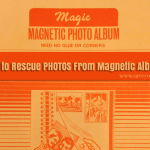
Acidic, cardboard pages. Covered in yellowing, sticky adhesive. Encapsulated in plastic sheeting. Spiral bound or three-ring binders. The magnetic photo albums so ubiquitous in the 1970s.
Personal photo organizers, archivists and conservators all agree that these inexpensive albums are among worst places to store your precious family photos. Your photos desperately need to be rescued from these cheap and harmful albums that have been their home for the past several decades.
What kind of damage have these albums been causing to your photos over the years? The cardboard pages are highly acidic and seep peroxide, yellowing both black and white and color prints. The tacky glue that seemed like such a convenience is also highly acidic and will slowly deteriorate the prints. Additionally, the glue breaks down, hardens and fuses the photo to the page making it difficult to remove. The cheap plastic overlay to the pages exacerbates the deterioration of the photos by off-gassing and sealing harmful chemicals in close to the photo print itself. Deterioration of prints in this type of album is hastened further if the albums are stored in unstable environments like the attic or basement where temperature and humidity fluctuations can wreck even more havoc on fragile images.
Personal photo organizers, archivists and conservators have developed certain techniques to help release photos from pages of the destructive1970s magnetic albums. These techniques are employed with the intention to prevent further damage to the photos themselves.
Waxed dental floss has been an effective tool for releasing photos from the pages. Slide the dental floss under a corner of the photo and gently saw through the glue as you pull the floss behind the photo. Take care not to tear the photo paper or bend the photo and crack the emulsion surface. Sometimes a small hair dryer on low or warm will be helpful to soften the glue just enough to slide the floss through. Take care not to overheat the page or the photo causing additional damage.
A product called Un-Du is available, generally utilized to remove labels and stickers. Place a small drop of Un-Du on a rounded, dull crafting spatula and slide the tool through the glue to help release a photo. Take care to use the smallest effective amount of Un-Du with each photo.Some pages will likely release the photos easier than others. Others could be a bit of a struggle. If the photo or photos are stuck hard to the page or to each other, scanning the entire page may be the simplest approach.
Finally, take care to preserve any notes or inscriptions from the album that go along with the photos before discarding the old pages. Sometimes this style of album just had a paper sheet at the beginning of the album where dates, places and names for each album page could be listed.
Take some time today and you can rescue your precious photos from a terrible fate of languishing in the harmful magnetic albums of the past.
Sign up today for more great photo organizing tips directly in your email box.
We also invite you to visit our sister blog The Photo Organizers for more tips and in-depth knowledge from some of the top photo organizing industry professionals. To find a photo organizer near you, visit the Association of Personal Photo Organizers.

Meaghan Kahlo, owner of Ephemera Photo Organizing of Seattle, WA, began her professional life with graduate work in museum studies focused on collections management. Her enthusiasm for photography and historical preservation combined with a passion to organize and create order are the driving forces behind her business. Meaghan helps clients transform the ephemeral nature of digital and printed images into meaningful photo solutions.